It’s easy to stay encouraged when you can see your hard work paying off. What helps you keep going when you can’t?
That question runs through this week’s Beyond the Scoreboard, from a comeback I nearly missed to the patience it takes to grow.
I counted the Texas Longhorns out last Saturday.
Down 23–3 to No. 1 Ohio State, I figured I already knew how the game would end, so I went to finish my weekend to-do list instead of watching it happen.
The next time I passed the TV, the score was 23–17, the Longhorns were at the 1-yard line, and there were only seconds left in the fourth quarter. I dropped the laundry basket and sat down.
Touchdown. Extra point. Texas wins 24–23. A 20-point deficit turned into a one-point, history-making win.
What a game.
I’ve been thinking about it all week. Not just the comeback, but how sure I’d been that Texas had already lost.
I took one look at the scoreboard and counted them out. But the Longhorns never counted themselves out. Down 20, against the top-ranked team in the country, they continued playing like the game was still theirs to win.
That’s what I hope our young athletes pay attention to: not the score, but how you continue to play the game when it’s not in your favor.
There’s a quote we read earlier this summer by Phil Jackson that comes to mind:
I understand that quote differently now than I had before. It’s easy to bring energy when you’re ahead. The real test is how you respond when you’re behind.
There will be games that give your athlete every reason to feel discouraged, facing a team, or a scoreboard, that isn’t in their favor.
Don’t make the same mistake I did and assume that means the game is over.
The Longhorns didn’t know a comeback was coming. They stayed ready for the next play, trusted their teammates, and gave their best when it mattered most anyway.
That’s the lesson. But I’d be lying if I said that’s the only thing I took from this game.
Because sometimes, that kind of fight is enough to make the person watching from their couch an instant fan.
By Sunday, I was proudly wearing my husband’s Arch Manning jersey. I’ve decided I’m a Longhorns fan now. 🤘
Oklahoma, I see you scrolling for that unsubscribe button. Please stop, we’ve come so far together!!
It doesn’t matter what team we’re cheering for, this is something we can all take into the next game. I counted the Longhorns out. They reminded me why we shouldn’t teach our athletes to do the same to themselves.
They don’t have to know how the game ends.
They just have to keep giving it everything they’ve got.
This week, Dr. Bob Rotella explores how athletes handle the parts of growth that test them: mistakes, challenging practice, competition, slow progress, and the opinions of others.
How does your athlete respond when something goes wrong? Can they move on to the next play, or does one mistake follow them through the rest of the game?
Rotella writes that what separates exceptional people is how they respond to failure. Even the best athletes lose, miss, and make errors. They learn to move on from a mistake so it doesn’t affect the next play. Because during the game, your attention belongs on the current play.
Afterward, you can look back and identify something to work on. But be mindful of the real difference between learning from a mistake and wallowing in it. Treat failure like an accident, something that happened, not something that defines you.
Rotella shares the advice Dean Smith gave young Michael Jordan: give yourself ten, maybe twenty minutes to reflect on a bad performance. That’s enough time to learn what there is to learn. After that, turn your attention to the next game, or better yet, think about something that has nothing to do with basketball at all.
“If all you do is keep reliving your mistakes, you’re going to destroy yourself,” Smith told him.
Rotella introduces “desirable difficulty”: adding the right challenges to practice to help skills develop.
Repeating something comfortable may feel productive, but practice should also prepare an athlete for the decisions and difficulties they’ll face in competition.
Quality over quantity, every time, even in practice.
Before the next practice, help your athlete answer:
A coach can help adjust familiar drills to add the right amount of challenge, like mixing pitch locations once a hitter is making consistent contact, or adding a baserunner so a fielder has to decide where to throw.
Rotella explains that exceptional athletes use competition to guide their preparation. Knowing what they’ll be up against helps them understand what they need to work on.
But once the game begins, that attention shifts. The real opponent is never the other team, it’s the athlete’s own mind.
Prepare for the competition. Then trust your preparation and play your game.
Part of being exceptional is knowing which one the moment calls for.
Rotella warns against chasing a new tip every time something feels off. He encourages athletes to stick with the fundamentals they’ve learned and accept that improvement rarely comes in a straight line.
That kind of patience shows up everywhere in a season. Patience with a slow start. Patience after an error. Patience in a rain delay. Patience when the at-bats are good but the hits aren’t falling yet. Most people aren’t raised to be good at waiting, and the better an athlete gets, the more patience the game demands of them.
Exceptional athletes resist the limits others place on them, but show patience with the work it takes to improve. They don’t know exactly when the work will pay off. They just know that it will.
No one becomes exceptional entirely on their own.
Rotella writes that athletes need people around them who believe in their talent, who tell them what they need to hear even when it’s not what they want to hear, and that they need to choose those people carefully.
He shares a story about being cut from his JV basketball team, his coach telling his father he’d probably never play organized ball past freshman year. His dad waited seven years to tell him, until after he’d been elected captain of his college team. That gap gave him room to draw his own conclusion instead of the coach’s: that guy’s a poor judge, I’ll show him.
Good coaches criticize, but they follow it with instruction, not just judgment. They know some athletes take criticism personally, and they make sure every player still walks into competition believing in themselves.
The lesson works both ways. When someone doesn’t believe in you, you can still choose who does, and let that belief carry you instead.
Ask your athlete: “Who’s someone who believes in you and pushes you to get better? Who’s someone whose attitude rubs off on you in a good way?”
Encourage them to notice the difference between a coach or teammate who criticizes to help them improve, and one who’s just being harsh. Both might sound tough in the moment. The difference is what comes after the criticism.
Does the athlete know what to do differently, or only what they did wrong?
There was a really good bit of the book this week about how careful exceptional people are with who they surround themselves with. Because attitudes are contagious.
Spend enough time around people with a certain work ethic, a certain optimism, a certain way of handling a bad day, and some of it starts to rub off on you.
This week, we’re asking your athlete to notice who that person is for them.
Let them sit with it.
They might name a teammate, a coach, an older player they look up to, or someone who has nothing to do with sports at all. There’s no wrong answer here, just pay attention to what they say made that person’s influence stick.
If they can name what it is, the effort, the attitude, the way that person treats others, that’s worth talking about too.
It might be exactly what they’re capable of
becoming for someone else.
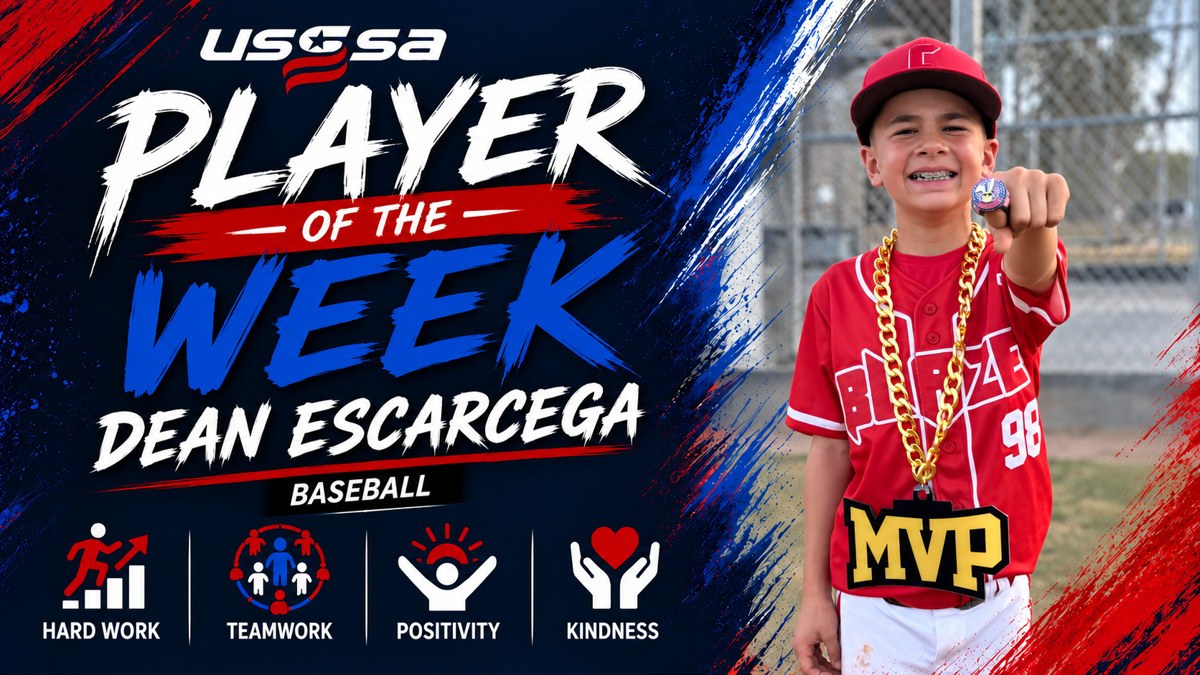
Dean Escarcega started out as a first baseman, known for scooping up nearly any throw that came his way. These days, he’s one of the top pitchers on his high-performance team, proof that hours of practice and a little stubborn determination pay off.
But what makes Dean stand out isn’t just what he does on the mound. It’s what he does for everyone around him.
He’s the one giving a playful bow to the pitcher when handing off the ball. The one running out to high-five the next batter on deck. The one keeping the dugout loud and positive, even after a rough inning.
He’s a great teammate because he treats everyone with kindness, and they trust him because when the team is down, Dean is usually the first one encouraging them to refocus.
Congratulations, Dean!
We’re proud to celebrate a player who makes the game better for everyone around him.
This October, USSSA is bringing pink to the fields with four limited-edition hats created for Breast Cancer Awareness Month.
The Stronger Together and Fighter designs recognize the strength of those facing breast cancer and the people standing beside them.
The collection also includes two classic USSSA designs, in pink and black.
Whether you wear yours for a fighter, a survivor, or someone whose memory you carry, we hope to see fields across the country filled with pink this October!
The collection will be available throughout October, while supplies last.
What do you want to read about?
Maybe it’s a topic we haven’t touched yet. A story or idea you’d like us to explore further. A question you wish someone would ask your kid in the car ride home.
Whatever it is, send it our way. This newsletter is for you, and we want to make it worth your Friday.